
Short answer
It depends on how much roof drains into each run, how steep that roof is, and how hard rain falls in a short burst. House gutters are usually 5 inch or 6 inch K-style. A long, steep roof often needs 6 inch, and every run needs enough downspouts to empty it.
What 5 inch and 6 inch measure
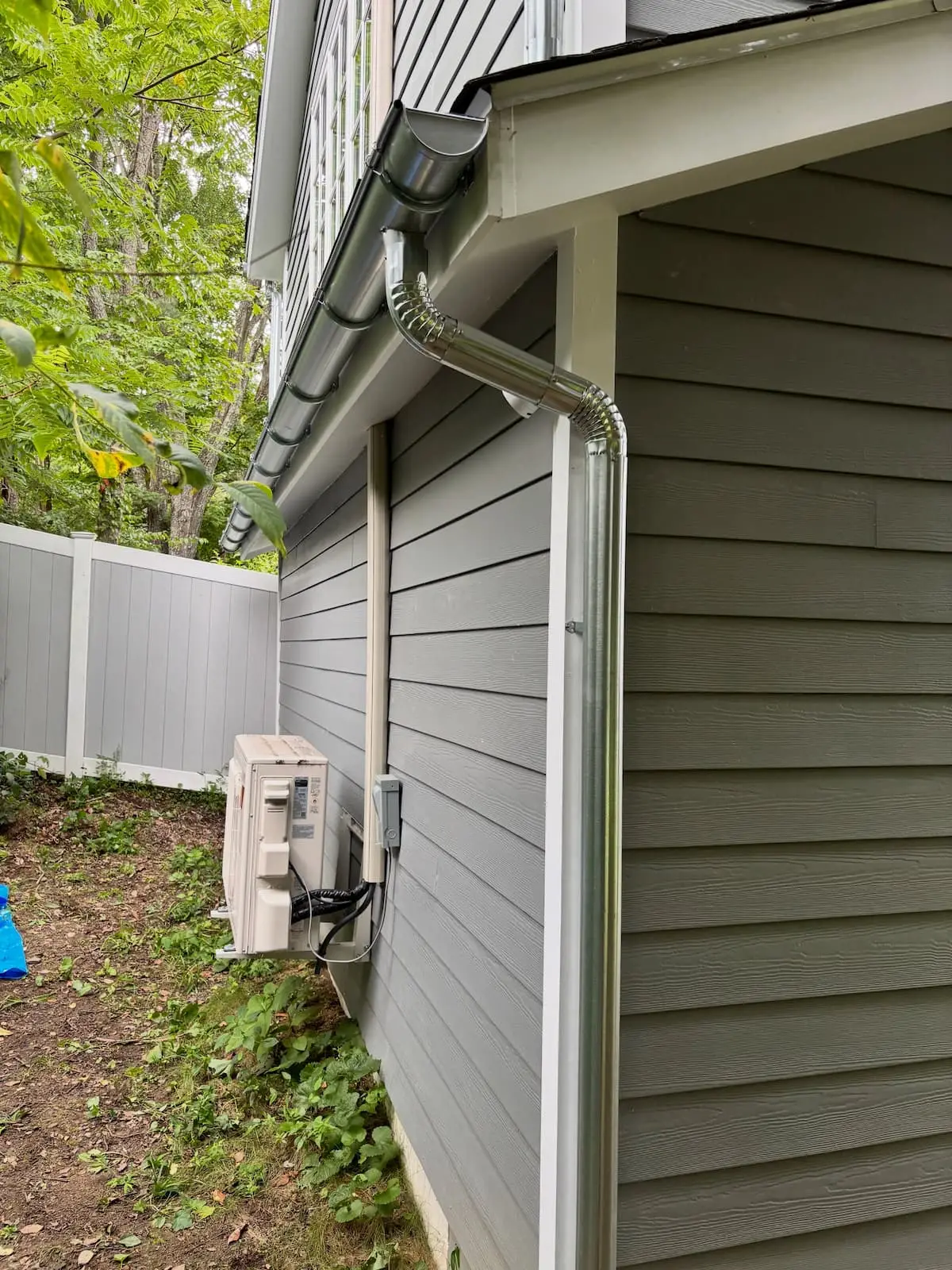
Most house gutters are K-style: a flat back against the fascia board and a front face shaped like crown molding. The size is the width across the open top. A 6 inch gutter is only an inch wider than a 5 inch one, but it is deeper too, so it holds and carries noticeably more water.
Downspouts come in matching sizes. The two common rectangular ones are 2 by 3 inches and 3 by 4 inches. A 3 by 4 downspout has a 12 square inch opening, twice the 6 square inches of a 2 by 3, so it drains a gutter about twice as fast.
Half-round gutters are measured differently and often show up on older or historic houses. The same reasoning applies to them.
The three things that decide the size
How much roof drains into the run
A gutter only cares about the roof directly above it. To size it, you measure the area of the roof plane that drains into that run, seen from above, as if you were looking down at a plan of the house. A roof slope that is 40 feet long and 15 feet from the gutter to the ridge puts 600 square feet of roof into that gutter.
Valleys change the picture. Where two roof planes meet in a valley, all the water from both sides runs down one line and lands on one short stretch of gutter. That stretch can overflow while the rest of the run is fine.
How steep the roof is
A steep roof catches more wind-driven rain on its face than a low one, and it sheds water faster. Sizing methods account for that by adding a pitch factor to the roof area, so a steep roof gets sized as if it were larger than its plan area.
How hard it rains in a short burst
This is the part people leave out. A gutter does not overflow because of how much it rains in a day. It overflows during the worst few minutes of a storm, when rain falls faster than the gutter and downspouts can carry it away.
NOAA measures exactly that. Its Atlas 14 data gives rainfall intensity for every location in the country, for bursts as short as five minutes. For a burst that comes along about once every 10 years on average, the rate is:
| Location | Worst 5 minutes, 10-year storm | Worst 5 minutes, 100-year storm |
|---|---|---|
| Newton (Sussex County) | 6.30 inches per hour | 8.81 inches per hour |
| Newark (Essex County) | 6.28 inches per hour | 8.18 inches per hour |
| Toms River (Ocean County) | 6.66 inches per hour | 8.78 inches per hour |
Those are rates, not totals. They do not mean six inches of rain falls in an hour. They mean that for those five minutes, rain comes down as fast as it would if it did.
The table shows something worth knowing. North Jersey gets far more snow than the shore, but a summer downpour hits the whole state about equally hard. A gutter in Newton needs to handle the same short burst as a gutter in Toms River. Sizing standards use short-duration rainfall like this to set gutter capacity.
A worked example
Take that 600 square foot roof plane and a burst of 6.3 inches an hour, about what a 10-year storm does for five minutes anywhere in the state.
Six point three inches an hour is a little over half a foot of water an hour. Spread over 600 square feet, that is about 315 cubic feet of water an hour, or roughly 39 gallons a minute pouring into one gutter. Add a pitch factor for a steep roof and the number goes up.
Whether a 5 inch gutter can carry that depends on its length, how it is pitched toward the outlet, and how many downspouts it has. What the example shows is the scale. During a heavy burst, a single roof plane can fill a 5 gallon bucket about every eight seconds, and all of it has to leave through the downspouts.
Downspouts matter as much as the gutter
The outlet is where most gutters fail. A gutter can only empty as fast as its downspouts let it, so a big gutter with one small downspout at the far end still overflows, starting at the end farthest from the outlet.
More downspouts, larger downspouts, or both, fix more overflow problems than a bigger gutter on its own. Placing them matters too. A downspout near a valley takes that concentrated water off the roof before it has to travel the length of the run.
Where the water goes after the downspout matters just as much. A downspout that empties against the foundation sends the water straight to the basement wall. It should carry the water far enough out that the ground can slope it away from the house.
Signs your gutters are too small
Clogged gutters and undersized gutters overflow the same way, so clean them before you judge. If clean gutters still overflow, look for these:
- Water sheeting over the front edge during heavy rain, while the gutter is clear.
- Overflow in the same spot every storm, often below a valley or at the far end of a long run.
- A line of splashed dirt on the siding or a trench worn into the mulch below the gutter.
- Water in the basement or crawl space after storms, near the corners of the house.
Water running behind the gutter, down the fascia, is usually a different problem: the gutter pitch or the drip edge at the roof edge, not the size.
Older New Jersey houses have their own problems
Half of the homes in New Jersey were built in 1971 or earlier, according to the Census Bureau. Many have had additions, porches and dormers added over the years, and the gutters were often extended piece by piece rather than sized again.
The common result is an upper roof that empties onto a lower one. The lower gutter then takes the water from both roofs, through the same size gutter and downspouts as before. When we size gutters on an older house, we follow the water from the top of the roof down and size each run for everything that ends up in it.
Bigger gutters do not stop ice dams
Gutters do not cause ice dams, and a larger gutter will not prevent them. The ice forms on the cold eaves because heat from the house melts the snow higher up. A gutter packed with ice is heavy, though, and that is one more reason to fasten gutters well. The cause and the fix are covered in Ice Dams in New Jersey: Why They Form and How to Stop Them.
Do you need a permit to replace gutters in New Jersey?
No. The state’s construction code lists “the repair, replacement, or installation of exterior gutters and leaders” as ordinary maintenance, with no permit and no notice to the town. That covers any building, not only houses.
Historic districts are the exception to watch. In Hoboken’s historic districts, for example, even an in-kind repair visible from the street gets a certificate of no effect from the Historic Preservation Commission. For the full picture on roofs and siding, see Do You Need a Permit for a New Roof or Siding in New Jersey?
How we size them
The gutter size and the number of downspouts depend on how much roof drains into each run and how steep it is. We measure each roof plane, look at where the valleys put their water, and check where every downspout empties. The size is written into your estimate. If your gutters are being replaced, the details are on gutter replacement, and new runs are covered under gutter installation.
Questions people ask about gutter size
Are 6 inch gutters always better than 5 inch?
No. A 6 inch gutter carries more water, but on a small roof with short runs a 5 inch gutter does the job, and it sits closer in scale to the house. What matters is matching the gutter and the downspouts to the roof above them. An oversized gutter with too few downspouts still overflows.
How many downspouts does a gutter need?
At least one per run, and long runs or runs below a valley usually need more. A gutter empties only as fast as its outlets allow, so adding a downspout, or moving to 3 by 4 inch downspouts, often fixes overflow without replacing the gutter. Where each downspout empties matters as much as how many there are.
Why do my gutters overflow when they are clean?
Usually the gutter is too small for the roof above it, it is pitched the wrong way, or there are too few downspouts. A long, steep roof puts far more water into a gutter than a short porch roof does. Watch where it overflows in a heavy rain: the spot usually points to the cause.
Do I need a permit for new gutters in New Jersey?
No. Gutters and leaders are listed as ordinary maintenance in the state construction code, for any building, so there is no permit and no notice to the town. If your house is in a historic district, check with the town first, because some commissions review exterior work visible from the street.
Sources
- NOAA National Weather Service, Hydrometeorological Design Studies Center. Precipitation Frequency Data Server, NOAA Atlas 14, partial duration series, rainfall intensity in inches per hour, for Newton (41.058, -74.753), Newark (40.735, -74.172) and Toms River (39.954, -74.198). Retrieved October 2, 2026. hdsc.nws.noaa.gov
- N.J.A.C. 5:23-2.7, Ordinary maintenance. Legal Information Institute, Cornell Law School. law.cornell.edu
- U.S. Census Bureau, American Community Survey 2024 1-year estimates, Table B25035 (Median Year Structure Built), New Jersey.
- City of Hoboken, Historic Preservation Commission.
Licensed New Jersey home improvement contractor, NJ HIC 13VH13268400. We repair and replace roofs, chimneys, gutters and siding in 14 New Jersey counties. Licensed and insured.