
Short answer
Often, yes. New Jersey lets you skip the permit only for work its construction code calls ordinary maintenance. Chimney masonry is not on that list, but a liquid-applied liner is. Work that affects structural or fire safety never counts as maintenance, so expect a permit for a rebuild. Your town's construction official makes the final call.
Why the answer is not a simple yes or no
New Jersey has one construction code for the whole state, the Uniform Construction Code. Each town enforces it through its own construction office, and that office decides what your job needs.
The code gives homeowners two ways around a full permit. The first is ordinary maintenance: no permit, no inspection and no notice to the town. The second is minor work: you tell the construction office before the work starts, then file a permit application within five business days. Everything else needs a permit before anyone picks up a trowel.
Chimneys are not named in either list. That is why two neighbors on the same street can get two different answers about the same kind of repair, and why the honest answer starts with “it depends on the work.”
What the code calls ordinary maintenance
The ordinary maintenance rule is N.J.A.C. 5:23-2.7. It lists the work you can do without telling anyone, and a lot of exterior work is on it. Replacing the roof covering on a detached one- or two-family house is on it. So is replacing the siding on a one- or two-family house, and so is “the repair, replacement, or installation of exterior gutters and leaders.”
One chimney item is on the list by name: “the application of liquid applied lining material inside an existing chimney.” That is a coating sprayed or brushed onto the inside of the flue. Nothing else about chimneys appears.
The rule says its list “is not an all-inclusive listing,” so a small repair that is not named can still count as maintenance. But the same rule draws a hard line in the other direction. Ordinary maintenance does not include “any work affecting structural or fire safety.”
Why chimney masonry is different
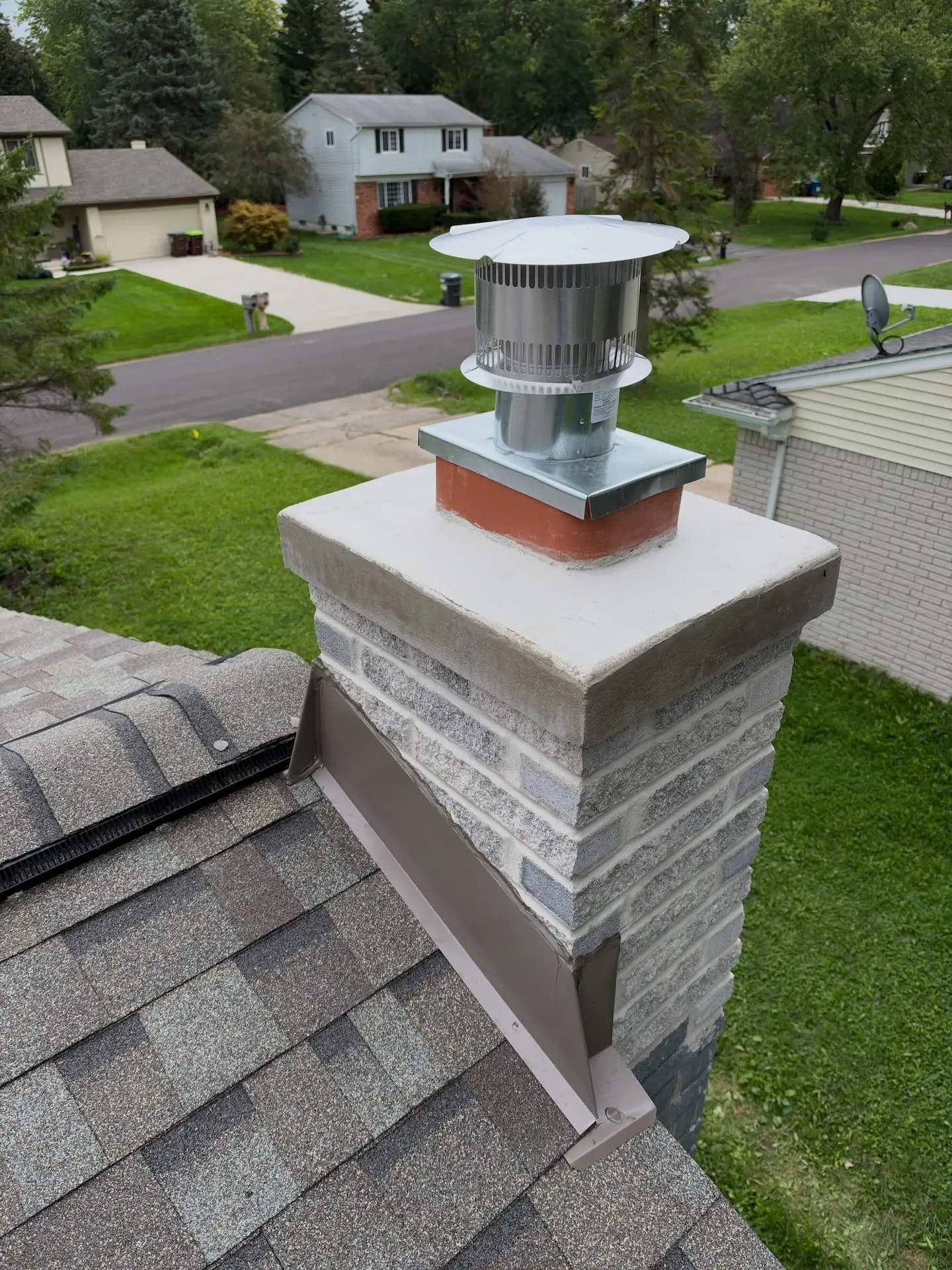
A chimney is there to carry smoke, heat and exhaust gases up and away from the wood framing around it. The brick, the mortar joints, the crown on top and the flue liner inside all do part of that job. When mortar crumbles out of the joints or the crown cracks, water gets in, the masonry weakens, and the flue can no longer be trusted to keep heat and gases where they belong.
That puts most chimney masonry on the fire safety side of the line. A stack is also a tall, heavy piece of masonry sitting on the house, so taking part of it down and building it back up is structural work as well.
How common chimney jobs tend to line up
This is how the code text maps onto the jobs homeowners ask about. It is a starting point for the conversation with your construction office, not a ruling.
- Liquid-applied liner inside an existing chimney. Named as ordinary maintenance. No permit, no notice.
- Replacing a chimney cap. Not named. A cap that bolts on top of the crown is often treated as a small repair, but ask.
- Repointing. Not named. Grinding out failed mortar and packing in new mortar is masonry repair. Some towns treat a small patch as maintenance and want notice or a permit for more. Ask before the work starts.
- Repairing or rebuilding the crown. Not named. The crown is the concrete or mortar cap that sheds water off the top of the stack. Expect the town to want to know about it.
- A new metal liner or any other liner change. Not named, and it changes how the appliance vents. Expect a permit.
- Rebuilding the stack. Taking the chimney down to solid brick and laying it back up is structural and affects fire safety. Expect a permit.
Where minor work fits
The minor work rule, N.J.A.C. 5:23-2.17A, covers “renovation or alteration work in an existing one or two-family dwelling, provided that no primary structural members are altered in any way, and further provided that the work does not constitute reconstruction.”
Some chimney repairs on a one- or two-family house can fit that description. When they do, the job can start once the town has been told, and the permit application follows within five business days. The notice can be “oral or written,” and it has to come before the work begins.
A rebuild is harder to fit. Taking a stack down and relaying it is close to the definition of reconstruction, so most homeowners should plan for a full permit and an inspection.
Historic districts add a second review
Some towns have historic districts with their own rules, and those rules sit on top of the construction code. A chimney is one of the most visible parts of an old house, so it is often covered.
In Hoboken’s historic districts, exterior work visible from the street goes to the Historic Preservation Commission, and even an in-kind repair gets a certificate of no effect from it. In Ocean Grove, part of Neptune Township, any exterior work needs a certificate of appropriateness from the commission first. Ridgewood and Montclair both have historic districts too, though there an exact, like-for-like repair can skip the commission review.
If your house is in a historic district, that review comes first, before any permit question.
Why New Jersey chimneys end up needing this work
Freeze and thaw is hard on masonry. Water soaks into mortar joints and porous brick, freezes, expands, and pushes the joint open a little further each time. The Office of the New Jersey State Climatologist counts about 163 freeze free days a year in the northern highlands and about 217 along the coast. Every weather station in the state has recorded 0°F or below.
The housing stock adds to it. Half of the homes in New Jersey were built in 1971 or earlier, according to the Census Bureau. Many of those chimneys have been through more than fifty winters.
How to find out for your house
The town decides, so start there.
- Find your municipal construction office. It is part of town hall, not the county. Most towns list a phone number on their website.
- Describe the job in plain words. Say what the work is, how much of the chimney it covers, and whether anything comes down. “Repointing about a third of the joints above the roofline” gets a clearer answer than “chimney repair.”
- Ask which path it falls under. Ordinary maintenance, minor work, or a full permit.
- Ask about a historic district. If the house is in one, ask what the commission needs before work starts.
- Get the answer into the estimate. Whoever quotes the job should say whether a permit is needed and who files it.
When we look at a chimney, we tell you whether your town needs a permit for the work, and it goes on the estimate. If you want to see what that work looks like, start with chimney repair or, for a stack that is too far gone, chimney rebuilding.
The rules for roofs and siding are much simpler. They are covered in Do You Need a Permit for a New Roof or Siding in New Jersey?
Questions people ask about chimney permits
Do I need a permit to repoint my chimney in New Jersey?
Maybe. Repointing is not named in the state's ordinary maintenance list, and the list excludes any work affecting structural or fire safety. Some towns treat a small patch as maintenance and want notice or a permit for larger jobs. Call your municipal construction office, describe how much of the chimney is involved, and ask before the work starts.
Does relining a chimney need a permit?
It depends on the liner. The code names one liner job as ordinary maintenance: applying a liquid lining material inside an existing chimney. A new metal liner, or any change to how a furnace, boiler or fireplace vents, is a different job. Expect the construction office to want a permit for that one.
Do I need a permit for a chimney cap?
A cap is not named in the code. A metal cap that bolts onto an existing crown is often treated as a small repair, but towns differ, and historic districts may review anything visible from the street. A quick call to the construction office settles it. Rebuilding the crown underneath the cap is a bigger job.
Who files the permit, the homeowner or the contractor?
Either can. The minor work rule says the notice comes from the owner, or from an architect or contractor acting on the owner's behalf. What matters is that someone files it before work starts. Ask whoever quotes the job whether the permit is included, who files it, and get both answers in writing.
Sources
- N.J.A.C. 5:23-2.7, Ordinary maintenance. Legal Information Institute, Cornell Law School. law.cornell.edu
- N.J.A.C. 5:23-2.17A, Minor work. Legal Information Institute, Cornell Law School. law.cornell.edu
- Office of the New Jersey State Climatologist, Rutgers University. "The Climate of New Jersey." climate.rutgers.edu
- U.S. Census Bureau, American Community Survey 2024 1-year estimates, Table B25035 (Median Year Structure Built), New Jersey.
- City of Hoboken, Historic Preservation Commission; Neptune Township, Historic Preservation Commission (Ocean Grove); Village of Ridgewood, Historic Preservation Commission; Township of Montclair, Historic Preservation.
Licensed New Jersey home improvement contractor, NJ HIC 13VH13268400. We repair and replace roofs, chimneys, gutters and siding in 14 New Jersey counties. Licensed and insured.